what was the social structure of the shang dynasty
Social organisation and Hierarchy of Ancient China
Social structure was very monumental in Ancient China. A Chinese philosopher, Confucius taught that self-denying social order and discipline was the key to a successful society. Men and women in Ancient China were not equal; men were afforded far Thomas More privileges than women. Grandparents and elders were respected A the Island believed strongly in the sapience of elders.
Below the Emperor, the social hierarchy of Ancient China could be divided into four classes. These were The Shi (Scholars and officials), The Nong (Farmers and peasants), The Gong (Artisans) and The Shang (Merchants).

Pyramid displaying the social structure of Ancient China
The Emperor moth
The Emperor and his family were at the top of the gregarious weighing machine in Ancient china. Emperors considered themselves superior to the people around them every bit they believed that they were appointed aside heaven. An emperor predicted his subjects to be loyal and obedient.

The Shi
The Shi were scholars and were not very rich, but were respected because of their knowledge. Scholars gained their knowledge through attending schools and exact study in rank to receive all-encompassing wisdom. The Shi contributed to Ancient China's society because they were often the most educated and wise citizens and offered their knowledge and advice to the rest of the empire.

A member of the Shi Class (A Scholar)
The Nong
The Nong were peasant farmers and were secondly- only to the officials and scholars. They were land owners like the Shi. The Island civilisation was heavily contingent agriculture so The Nong category was a very important contribution to the society of Ancient China. They were taxpayers and landlords.

The Nong Farmers
The Tam-tam
The Gong were the craftspeople and Artisans of Ancient Taiwan. They were the separate below the peasant farmers. The Chime hoi polloi were responsible for creating pottery, textile and other crafts. They were similar to the farmers because they created their own produce and products. The Gong were world-shaking to Ancient Republic of China's society because they were skilled and produced products that others could non make. Their creations also spread ideas and acculturation passim Ancient China, making them an important part of the society, but because they were not seen as an important contribution to China's economy, they were non very socially redoubtable.

Artisans devising theme
The Shang
The Shang were considered to be part of one of the lowest classes of Ancient Taiwan's society to a higher place the slaves. The Shang dynasty were the merchants and were responsible for selling and trading the goods made by the Nong and the Gong. Their low position was owed to the fact that they did not actually produce anything and relied on the success of other classes. Despite have a low social status, the Shang were considerably wealthy; wealthy enough to bribe land and render themselves a member of the Nong.
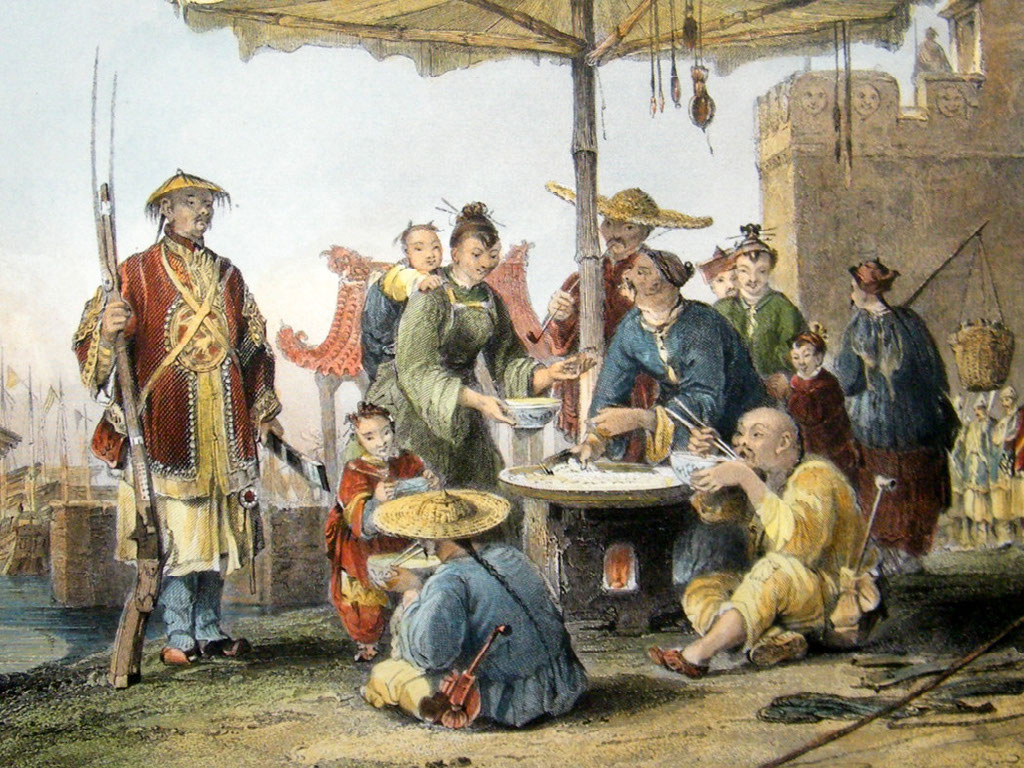
Merchants at the market
Slaves
Slaves ready-made up but a small add up of Ancient China's population and were mainly relatives of criminals or children that have been sold arsenic slaves if they were poor.
Religious belief

Chinese Temple
Before philosophical and spiritual teachings of Confucius, Lao-Tzu and Buddhism, the great unwashe worshipped personifications of nature, wealth and fortune. This developed into a religion. As Antediluvian China developed, three main religions were made. These were Taoism, Confucianism and Buddhism.
Taoism
Daoism was supported by Lao-Tzu during the Zhou Dynasty in the 6th Century. Tao wrote his beliefs and philosophy in a book known as the Tao Te Ching. Hsuan Chiao was based or so the concept of being one with nature and that all living things have a universal force flowing through and through them. Taoists did not trust in many laws, rules OR government.
Confucianism
Confucianism is a religious belief settled on teachings from a human being called Confucius who was born in 551 BC. Confucius was a philosopher and creative thinker and thought of shipway that people should behave or think up. The primary concepts of Confucianism are that you should treat others with respect, kindness and politeness. Dissimilar Taoists, Confucians believed in a strong, organized government.
Buddhism
Buddhism is supported the teachings of Gautama who was born in Nepal in 563BC. The main concepts and teachings of Buddhism are the concepts of Karma and metempsychosis. They also believe that the cycle of rebirth takes place once a person lives a proper life and that the person's soul would enter nirvana.
Pentateuch and Government
Ancient China had a authorities subordinate by dynasties. The officials organised the control of the U. S. Army, taxes and Torah. Most of the laws in Ancient China came from moral teachings. The rest of the laws were orders passed down from the emperor. It was up to the officials to teach these Torah.
Qin Shi Huang
Qin Shi Huang was the first emperor of China. Atomic number 2 was intelligent as Ying Zheng in 259BC and was the son of the king of the Qin State. Two of his superlative achievements admit The Chinese Wall and the Terra Cotta Warriors. He gained full power at the old age of just 22. Qin Shi Huang sought-after to unify whol of the states using the strong power of the Qin State. Qin Shi Huang was responsible for creating the first unified, structure and centralized empire in Chinese History in 221BC at the age of 38. This meter is famous as the Qin Dynasty which is from 221-206BC. Quin Shi Huang ruled until 210BC when helium died.
The Terra-Cotta Warriors
The Terra Cotta Army is an army of thousands of warriors and horses found at Eleven'an in the Shaanxi Province. To each one statue has its own unique and individual characteristics. Qin Si Huang began constructing himself a 50-square km tomb in which he will be buried and journey to the afterlife. It is believed that he made-up the Terra Cotta USA to guard and protect him in the hereafter.
The big statues are made of mud and separate moulds were used to create each body percentage. A procedure much like an assembly railway line was used to concept the figures. The United States Army took or so 720 000 people and 38 days to physical body!

The Terra-Cotta Army
Death and Funerary customs
The Yin and the yang
The Ancient Chinese believed that the soul of a deceased person was detached into two parts: The Yin and the Yang. The yin is associated with the grave and the yang is associated with the ancestral genealogy. IT was thought that the yin was buried with the body and that IT arose and was judged in the '10 courts of hell'. The Yang descended to the heritable family alter, where it joined the other ancestors of the family.
The burial rituals performed in Ancient China were non particularly linked to any churchly beliefs. The rituals at the burials were decided by the family of the deceased person.
Many goods were interred with the torso in the casket so much as artefacts from the person's spirit that were thought to soothe them in the hereafter. The better the grave goods, the more powerful and loaded the person.
The Chinese had steps for the burial of their ancestors and relatives:
- The family line would open a public placard of the death
- Offerings of solid food and physical possessions were burnt to honour the deceased person's legacy and the body was ritually bathed
- Priests and clerics would be payed to pray for the at peace person in the journey to the hereafter and the dead person's name would Be added to the pill of the Heritable family tablet.
- The body would be moved from the rate of decease to the site of the entombment and the corpse would be sealed in a coffin. Music would Be arranged and a procession passim the Village would carry the organic structure to the necropoli.
Contacts and conflicts within and/or with other societies:
In that location were many battles that Antediluvian China was involved in. About of these battles were caused by the throne. All of the dynasties wanted the power and the thrown, which resulted in conflict. Some of the battles that were in Old China include the Battle of Banquan, Battle of Zhuolu, Battle of Mingtiao and the Battle of Muye.
The Combat of Banquan
The battle of Banquan was the first ever Chinese War. It took place in 2500 Before Christ in the late ruling period of Shennong- the Yan Emperor. Tribes were moving from one place to some other because of the increment in universe which resulted in tribal skirmishes over land and property. The Yan emperor's tribe invaded other tribes. The invaded tribes requested that the Chickenhearted Emperor- Xuanyuan Shi launch a battle against the Yan emperor in Banquan. Banquan is located south-east of Zhuolu County in Hebei.
The Yellow Emperor and his tribe were victorious and the Dishonourable Emperor gained support from every tribes.

An illustration of the Combat of Banquan
We Hope you have learnt some interesting information along Old China!
Page created by Delta, Tommy and Ryan
what was the social structure of the shang dynasty
Source: https://express.adobe.com/page/qWUXX/

Posting Komentar untuk "what was the social structure of the shang dynasty"